

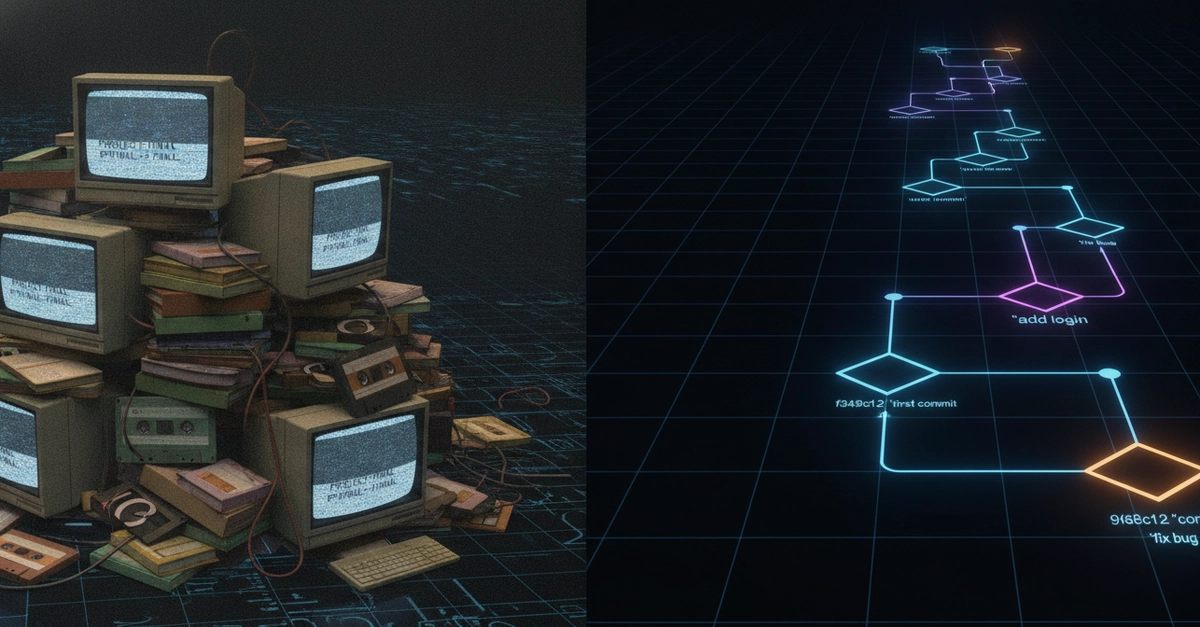
On April 7, 2005, Linus Torvalds made the very first commit to a new, experimental version control system he called "Git." Written in a feverish, ten-day burst of development, the software was born out of sheer necessity and a highly publicized licensing dispute.
Twenty years later, Git has transitioned from a specialized tool built for Linux kernel developers into the undisputed backbone of the global software industry. Today, it manages the source code of everything from indie mobile apps to the proprietary infrastructure of multinational giants like Google, Microsoft, and Meta.
To understand how Git achieved this total hegemony, one must look past its complex command-line interface and examine the fundamental problem it solved, the dramatic crisis that forced its creation, and the psychological shift it introduced to modern engineering.
1. Main Facts: The Paradigm Shift in Version Control
At its core, Git is a distributed version control system (DVCS). It tracks and records every change made to a project’s files over time, providing a transparent, navigable audit trail of what was changed, when it was changed, and by whom.
[Typical manual backup chaos: A developer's worst nightmare]
project-final/
├── project-final-v2/
├── project-final-v2-fixed/
├── project-final-v2-final/
└── project-final-v2-final-final/
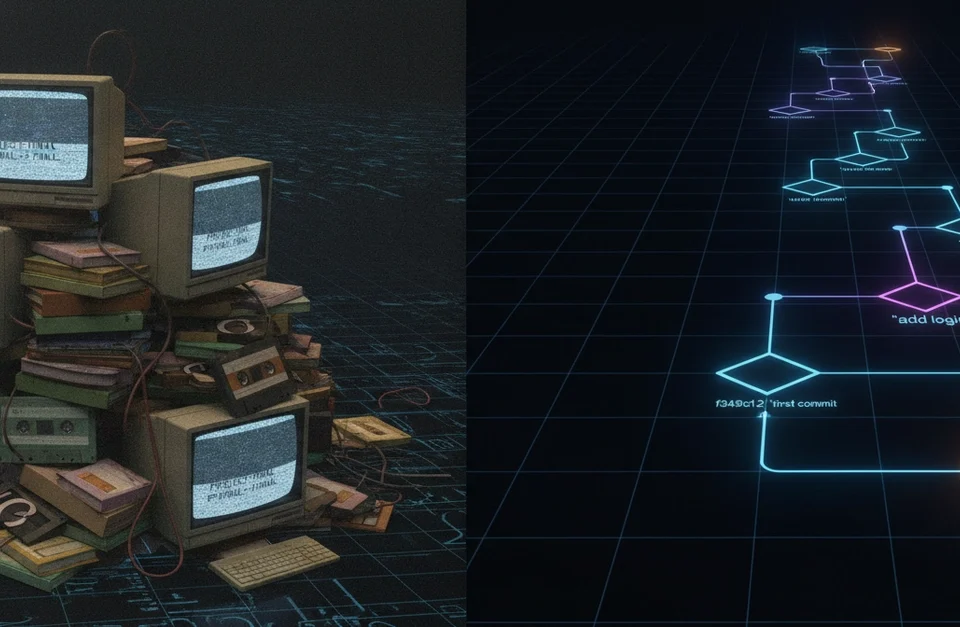
Before version control systems became standard, developers managed project iterations by manually duplicating directories. This approach inevitably resulted in "folder hell"—a disorganized cluster of directories with names like project-final-v2-final. Under this manual system, determining which directory contained the actual production-ready code was difficult, and reverting a breaking change required manual, error-prone reconstruction.
The Commit as a Snapshot
Git replaced manual backups with the concept of the commit. Unlike older version control systems that recorded file differences (deltas) over time, Git views data as a stream of snapshots of a miniature filesystem. Every time a developer saves their progress via a commit, Git takes a picture of what all the files look like at that exact moment and stores a reference to that snapshot.
The Power of Distribution
The defining characteristic of Git is its distributed nature. In older, centralized version control systems (CVCS) like Subversion (SVN) or CVS, there was a single central server containing the project history. If a developer was offline, they could not commit changes or view history. If the central server’s hard drive became corrupted and lacked backups, the entire history of the project was lost.
Git, however, operates on a peer-to-peer model. When a developer clones a repository, they do not just check out the latest tip of the source code; they mirror the entire repository history onto their local machine. Every contributor possesses a complete backup of the project. This design eliminates single points of failure and allows developers to commit, branch, and view history entirely offline.
2. Chronology: From Email Patches to a Global Standard
The journey of Git from a localized emergency tool to a global industry standard spans over three decades of collaboration challenges.
[TIMELINE OF GIT'S EVOLUTION]

1991–2002: The Manual Era
  └── Linux kernel changes managed via tarballs and email patches.

2002: The BitKeeper Era
  └── Linux community adopts BitKeeper (proprietary DVCS) under a free license.

2005 (Spring): The Licensing Crisis
  └── Andrew Tridgell develops SourcePuller; BitMover revokes the free Linux license.

2005 (April 3): Linus Torvalds Begins Writing Git
  └── Torvalds starts coding a brand-new distributed version control system.

2005 (April 7): The Historic First Commit
  └── Git becomes self-hosting; Torvalds uses Git to commit Git's own code.

2005 (June–Dec): Transition & 1.0 Release
  └── June: Git manages Linux releases. Dec: Git 1.0 released; Junio Hamano takes over.

2007–2011: The Hosting Boom
  └── GitHub (2007), Bitbucket (2010), and GitLab (2011) are founded.

2018: Enterprise Consolidation
  └── Microsoft acquires GitHub for $7.5 billion, cementing Git's industry dominance.
1991–2002: The Manual Era
For the first decade of the Linux kernel’s existence, development was highly decentralized and technically primitive. Contributors from around the world mailed patch files (textual representations of code changes) to mailing lists. Linus Torvalds manually reviewed these patches and merged them into his local source tree, releasing updated compressed archives (tarballs).
As the Linux project grew to include thousands of contributors, this manual workflow became unsustainable. Established centralized tools like CVS and SVN were rejected by Torvalds because they were too slow, required continuous network access, and struggled with the branching workflows required for kernel development.
2002–2005: The BitKeeper Era
To resolve this bottleneck, the Linux kernel team in 2002 adopted BitKeeper, a proprietary distributed version control system developed by Larry McVoy’s company, BitMover. BitKeeper was ahead of its time, offering the speed and distributed workflow the kernel team needed.
BitMover provided a free-of-charge license to the Linux kernel community, but it came with strict conditions: developers using the free version were prohibited from working on competing version control projects, and they were forbidden from reverse-engineering the BitKeeper protocols. While this compromise allowed the kernel to scale its development pace, it remained a point of friction within the broader open-source community, which objected to relying on closed-source software.
The Spring 2005 Crisis
The arrangement collapsed in early 2005. Andrew Tridgell, a prominent Australian open-source developer famed for creating Samba, developed a client called SourcePuller. The tool interacted with the BitKeeper protocols to help developers extract metadata without using the proprietary BitKeeper client.
BitMover argued that Tridgell’s work constituted reverse engineering, which violated the license agreement. Following a tense standoff, Larry McVoy announced the revocation of the free BitKeeper license for the Linux kernel project. Suddenly, thousands of kernel developers were left without their primary collaboration tool.
Ten Days That Changed Software Development
Faced with a halt in kernel development, Linus Torvalds decided to write his own tool. On April 3, 2005, he began writing the code.
By April 7, 2005, Torvalds made the first official commit to the Git repository. The tool was already stable enough to be self-hosting, meaning Torvalds used Git to track and commit the source code of Git itself.
By June 2005, Git was robust enough to manage the official Linux kernel releases. In December 2005, Git 1.0 was released, and Torvalds handed over maintenance of the project to Junio Hamano, a Japanese software engineer who has steered Git’s development ever since.
3. Supporting Data: Performance, Scale, and Industry Dominance
The technical success of Git is rooted in its design principles, which were built to handle the sheer scale of the Linux kernel.
Performance Requirements
When designing Git, Torvalds set a strict performance target: applying a patch and committing it had to take less than three seconds. At the time, kernel development required processing up to 250 patches simultaneously from different maintainers. Centralized systems of the era took several seconds—sometimes minutes—per transaction over a network, a latency that would have stalled kernel development entirely.
Cryptographic Integrity and Hashing
Rather than relying on simple file version numbers (like SVN’s r1, r2), Git utilizes the SHA-1 cryptographic hashing algorithm (and is gradually transitioning to SHA-256 for improved security).
[How Git Cryptographically Links Commits]

   Commit A (Hash: 3a4f1c...)
     └── Parent: None
     └── Tree: (Files snapshot)
     └── Message: "Initial commit"
              ▲
              │ (Linked via Parent Hash)
   Commit B (Hash: 8b2e9d...)
     └── Parent: 3a4f1c...
     └── Tree: (Files snapshot)
     └── Message: "Fix memory leak"
Every file, directory structure, and commit in Git is represented by a unique 40-character hexadecimal string generated from its contents. This approach guarantees complete data integrity:
- If a single byte of code is corrupted or maliciously altered during transit, its computed hash changes.
- Git detects this mismatch immediately, making it impossible to alter history without detection.
Economic and Industry Scale
Git’s efficiency laid the groundwork for massive commercial platforms that transformed the tech economy.
- GitHub (Founded 2007): Built a social network and web interface around Git. By the time Microsoft acquired it in 2018 for $7.5 billion, it had become the central hub of global open-source software. Today, GitHub hosts over 100 million developers and more than 420 million repositories.
- Enterprise Adoption: According to industry developer surveys, over 93% of modern software developers use Git as their primary version control system. Centralized systems like SVN, TFVC, and Mercurial have largely been relegated to legacy systems.
4. Official Responses and Key Voices
The history of Git is punctuated by the strong personalities and pragmatism of its creators and critics.
Reflecting on the crisis that forced his hand, Linus Torvalds recalled his mindset in 2005 with characteristic bluntness:
"I’ll do something that works for me, and I won’t care about anybody else."
Torvalds did not set out to build a tool for the world; he built a tool to solve his immediate workflow issue. When asked about the name "Git," which is British slang for an unpleasant or contemptible person, Torvalds offered a self-deprecating explanation:
"I’m an egotistical bastard, and I name all my projects after myself. First ‘Linux’, now ‘Git’."
He also noted that the name was short, pronounceable, unassigned to any standard UNIX command, and inspired by the lyricism of the Beatles song "I’m So Tired."
                     ┌───────────────────────────┐
                     │   The BitKeeper Crisis    │
                     │          (2005)           │
                     └─────────────┬─────────────┘
                                   │
                    ┌──────────────┴──────────────┐
                    ▼                             ▼
       ┌─────────────────────────┐   ┌─────────────────────────┐
       │      Larry McVoy        │   │     Linus Torvalds      │
       │      (BitMover)         │   │    (Linux Creator)      │
       ├─────────────────────────┤   ├─────────────────────────┤
       │ "Protect intellectual   │   │ "We need a tool that is │
       │ property and licensing  │   │ open, fast, and cannot  │
       │ agreements."            │   │ be taken away."         │
       └─────────────────────────┘   └─────────────────────────┘
On the other side of the dispute, Larry McVoy defended BitMover’s decision to revoke the free license, arguing that open-source contributors had to respect the intellectual property of the tools they relied on. The dispute highlighted a fundamental tension in early-2000s tech culture: the reliance of open-source projects on proprietary platforms.
In its early years, Git faced criticism for its steep learning curve. Developers accustomed to SVN’s simple command vocabulary (svn checkout, svn commit) struggled with Git’s distinction between the "working directory," the "staging area" (index), and the "local repository." Early users complained of a system designed by a genius for geniuses, featuring cryptic commands and complex concepts like "rebase," "detached HEAD," and "cherry-pick."
Over time, however, the developer community adapted. Comprehensive documentation, GUI clients, and platforms like GitHub made Git’s powerful mental model accessible to developers of all skill levels.
5. Implications: How Git Unlocked the Era of Continuous Delivery
The impact of Git extends far beyond resolving a 2005 licensing dispute. It fundamentally changed how software is designed, tested, and shipped.
[Modern Git-Driven CI/CD Pipeline]

Local Dev Branch ──► Pull Request ──► Automated Testing ──► Merged to Main ──► Production Deploy
 (Feature Work)     (Peer Review)      (CI Server Runs)     (Git State Syncs)    (Live to Users)
Psychological Safety and Bold Experimentation
Before Git, branching (creating a separate copy of the code to develop a feature) was a slow and expensive operation in centralized systems. Developers often worked on the same main branch, leading to broken builds and slow release cycles.
Git made branching near-instantaneous and cheap. Because branches are just lightweight pointers to commits, developers can spin up a new branch to test an experimental feature and discard it if it fails. If they make a mistake, Git’s local history keeps track of their changes, allowing them to recover lost work using tools like git reflog. This safety net encourages bold refactoring and experimentation.
The Rise of "Social Coding"
Git’s architecture enabled the Pull Request (PR) model, pioneered by GitHub. Instead of pushing code directly to a shared repository, developers fork or branch the codebase, commit their changes locally, and submit a PR for peer review.
This workflow transformed code review from an occasional, formal event into a continuous, collaborative conversation. It democratized open-source contribution: anyone, anywhere, can fork a public repository, make a change, and submit a pull request to the maintainers.
The Foundation of DevOps and GitOps
In the modern cloud-native era, Git has expanded beyond application source code to manage infrastructure. The paradigm of Infrastructure as Code (IaC) relies on Git to track changes to server configurations, cloud resources, and deployment pipelines.
This has culminated in GitOps, a practice where the entire state of an IT infrastructure is defined within a Git repository. Automated systems continuously monitor the Git repository; when a change is merged into the main branch, the system automatically updates the live production infrastructure to match.
Conclusion: An Accidental Masterpiece
When Linus Torvalds sat down to write Git in April 2005, he was trying to save the Linux kernel project from administrative gridlock. He did not set out to build a tool that would define the modern tech industry.
Yet, by prioritizing performance, data integrity, and a fully distributed architecture, Torvalds created an accidental masterpiece. Twenty years later, Git remains a quiet, powerful force behind the global software ecosystem—a testament to how a single well-engineered tool born from crisis can change the world.